
The Chemical Mystic - Neuroscience and Transcendent Experience
1. Donahue, William. "550 A New You Part 1." Lecture. *Hidden Meanings*, 2011.
Throughout history, the human experience has been punctuated by moments of transcendence—mystical states where the boundaries of the self dissolve, time seems to halt, and one feels profoundly united with existence [1]. For centuries, these phenomena were interpreted solely through spiritual or metaphysical lenses. However, modern neuroscience now reveals that these profound experiences possess specific, measurable neurological correlates, involving distinct patterns of brain activity and particular neurotransmitter systems. This convergence of the spiritual and the material compels us to ask whether explaining mystical states through brain chemistry diminishes their significance, or if it instead uncovers a deeper truth about the inherent capacity of matter to generate the transcendent.
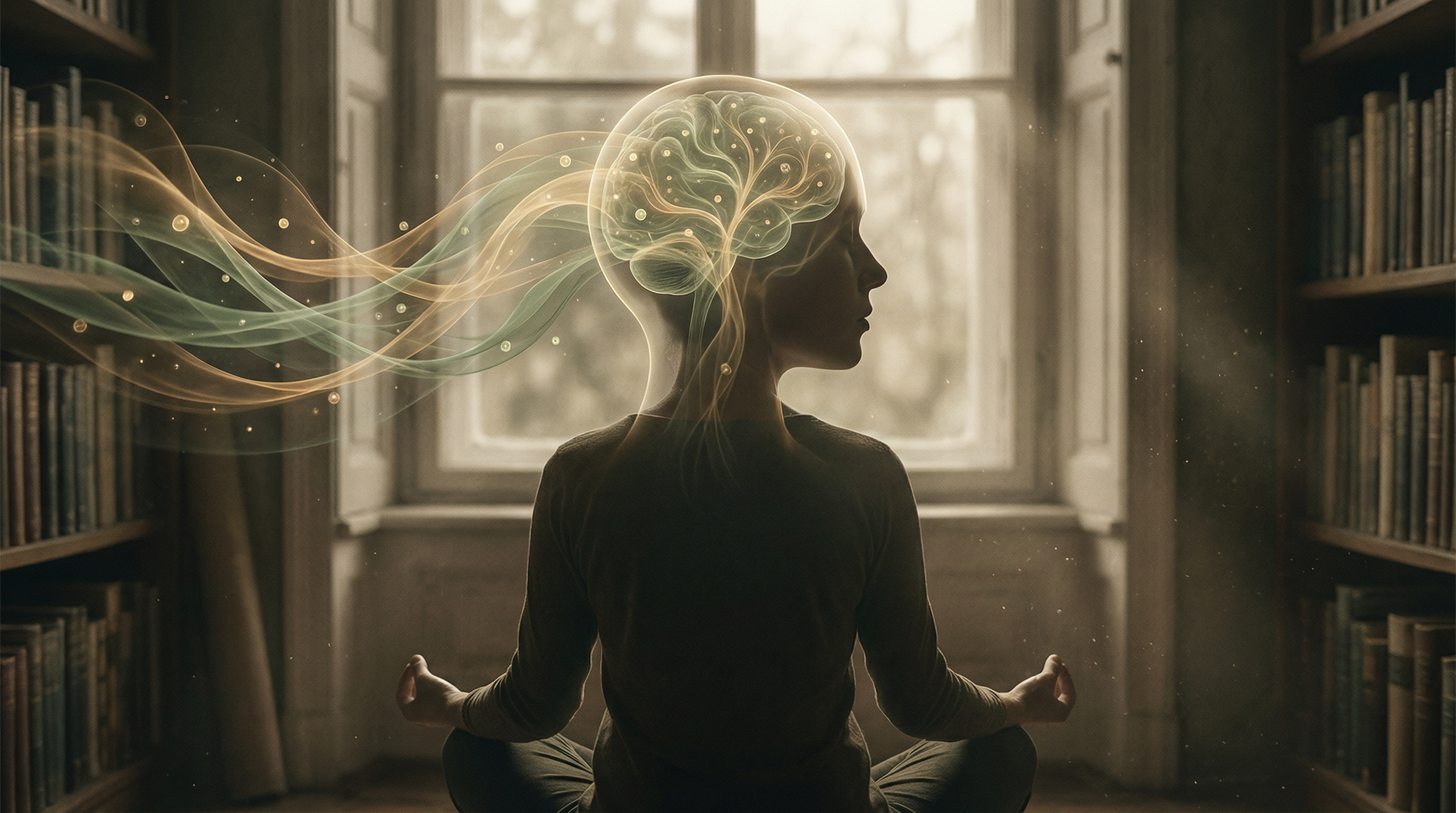
Research into the neuroscience of transcendence, utilizing neuroimaging on meditators, psychedelic users, and individuals reporting spontaneous mystical experiences, consistently points to the role of the Default Mode Network (DMN). The DMN is typically active during self-referential thought and mind-wandering, essentially maintaining the sense of a separate, distinct self. Crucially, studies demonstrate that the mystical experience of "ego dissolution"—the feeling that the self has merged with everything else—is directly correlated with a significant decrease in DMN activity. The more profound the reported unity, the greater the observed dampening of this self-referential network.
[Image blocked: Person meditating with subtle neurotransmitter visualization]
Further investigation highlights the critical role of neurotransmitters, particularly serotonin. Psychedelic compounds like psilocybin and LSD induce mystical states by activating the serotonin 2A receptors, leading to profound shifts in perception and self-awareness often characterized by feelings of unity and ineffability. While psychedelics are potent inducers, altered states of consciousness can also be achieved through endogenous means, such as intense meditation, rhythmic breathing, or fasting, all of which influence serotonin and other systems. Dopamine contributes to the feelings of bliss, and endorphins promote well-being, demonstrating that the full mystical state is a complex, multi-system chemical event.
Despite the diverse paths to achieving them—be it through prayer, psychedelics, or meditation—mystical experiences share common phenomenological features, as cataloged by William James [2]. These include ineffability (defying verbal description), a noetic quality (feeling like a profound revelation of truth), transiency, and passivity (feeling like the experience happens to the individual). Modern scales confirm that these features remain constant across different induction methods, suggesting that the mystical experience is not merely a cultural construct but rather a fundamental, shared capacity of human consciousness, rooted deeply in the brain's structure and function.
[Image blocked: Serotonin and dopamine molecules as luminous forms]
The existence of neurochemical correlates does not render mystical experiences "nothing but" chemistry; rather, it reveals that transcendence emerges from the material body. Just as love is not diminished by knowing it involves oxytocin, the profound meaning of a mystical state is not lessened by its reliance on serotonin. This insight suggests that the sacred is not opposed to the material but is grounded within it. The brain, a complex organ, is capable of generating experiences of cosmic unity and infinite love, confirming that the material world possesses the extraordinary capacity for self-transcendence, thus blurring the traditional dichotomy between the spiritual and the physical.
Carl Jung emphasized the necessity of encountering the numinous—the sacred or wholly other—for psychological health, viewing these experiences as encounters with the Self, the organizing center of the psyche [5]. While transformative, Jung cautioned against "inflation," where the ego dangerously identifies with the universal content of the experience. Research confirms that mystical experiences, particularly those induced by psychedelics, can lead to lasting positive changes, including increased openness and decreased anxiety [3]. However, the experience itself is only the first step; true transformation requires the careful integration of these insights into one's character and daily conduct.
[Image blocked: Person in meditation with glowing brain activity]
The understanding that mystical experience is a natural, neurochemically grounded human capacity effectively democratizes it, making it accessible beyond traditional spiritual elites. With the rise of widespread meditation and the imminent therapeutic use of psychedelics, more individuals are gaining access to these transformative states. This accessibility presents both an opportunity for profound personal growth and a challenge: ensuring that these powerful experiences are approached with respect, proper preparation, and robust support for integration. The goal remains not merely to seek extraordinary states, but to embody the wisdom gleaned from them, transforming character and conduct in alignment with the insights of unity and meaning.
Sources: [1] Stace, W. T. (1960). Mysticism and Philosophy. Lippincott. [2] James, W. (1902). The Varieties of Religious Experience. Longmans, Green & Co. [3] Griffiths, R. R., Johnson, M. W., Carducci, M. A., Umbricht, A., Richards, W. A., Richards, B. D., Cosimano, M. P., & Klinedinst, M. A. (2016). Psilocybin produces substantial and sustained decreases in depression and anxiety in patients with life-threatening cancer: A randomized double-blind trial. Journal of Psychopharmacology, 30(12), 1181–1197. [4] Carhart-Harris, R. L., Leech, R., Hellyer, M. J., Shanahan, M., Feilding, A., Tagliazucchi, E., ... & Nutt, D. J. (2014). The entropic brain: a theory of conscious states informed by neuroimaging data. Frontiers in Human Neuroscience, 8, 20. [5] Jung, C. G. (1968). Man and His Symbols. Dell Publishing.