
DNA as Ancestral Memory - The Biological Unconscious
1. Donahue, William. "550 A New You Part 1." Lecture. *Hidden Meanings*, 2011. [https://youtu.be/CNWPA9fiEo4](https://youtu.be/CNWPA9fiEo4)
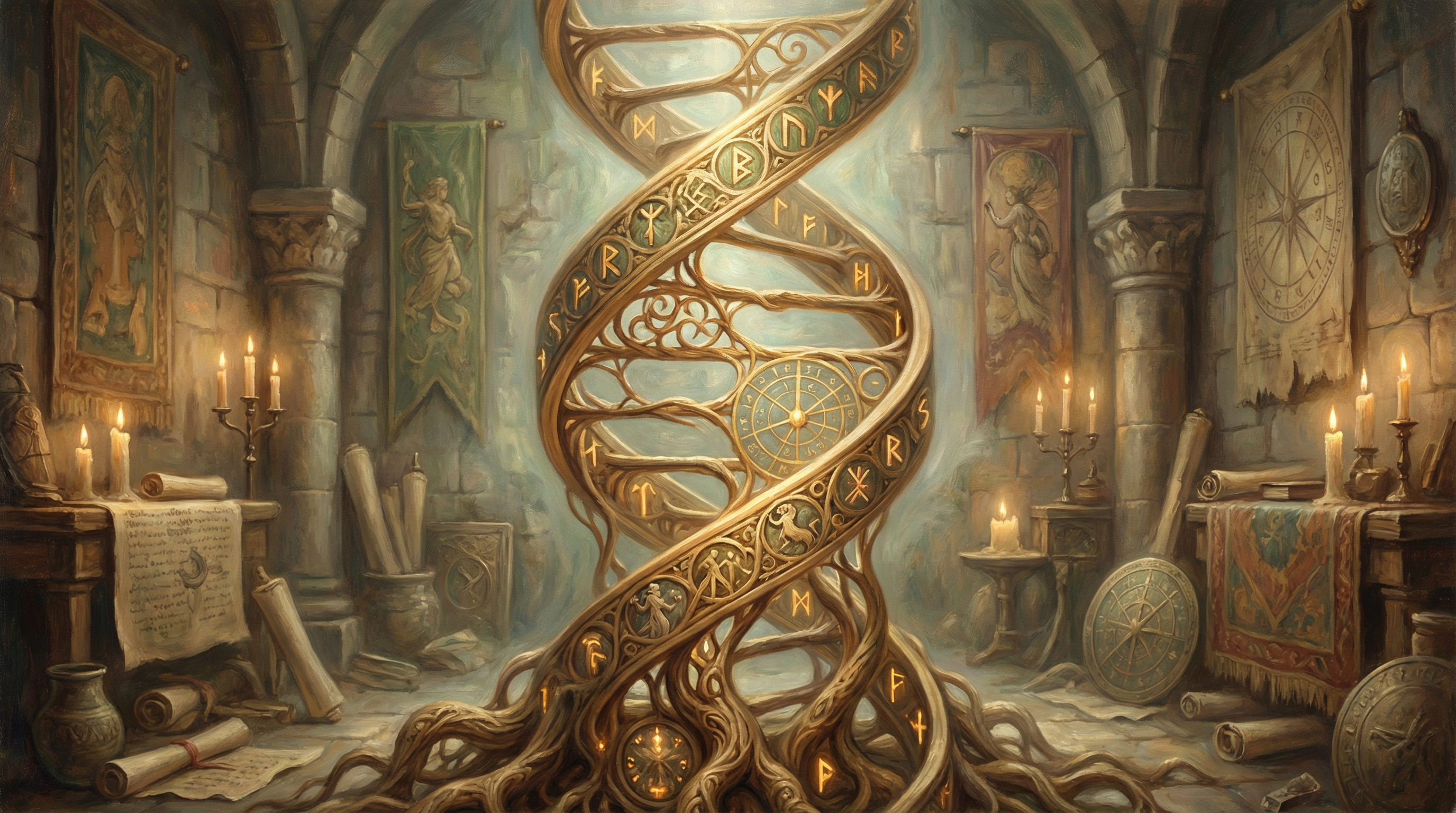
Within each human cell, DNA functions as far more than a biological blueprint; it acts as a library of ancestral memory, encoding not just physical traits but also behavioral predispositions and deep psychological patterns. This molecular structure, containing billions of base pairs, represents the complete instruction manual for life, stretching back across billions of years of evolution. We are the latest expression of this unbroken chain, carrying within our genome the accumulated wisdom and, crucially, the trauma of countless generations. Understanding this profound genetic inheritance is essential for self-knowledge, offering a key to unlocking our potential for personal and collective transformation.
[Image blocked: DNA helix glowing with ancestral light]
The discovery of the double helix structure provided the molecular basis for heredity, revealing how traits are passed and how evolution operates at the genetic level. Sequencing the human genome confirmed our deep interconnectedness, showing significant shared DNA with all life forms, from chimpanzees to yeast, confirming Darwin’s insight that all life shares a common ancestor. This genetic continuity suggests that the differences between species are matters of degree, not kind, rooting human psychology firmly within the broader context of natural history.
The genome is not a static blueprint but a dynamic, responsive system where genes represent potentials rather than fixed destinies. Much of the non-coding DNA, once dismissed as "junk," plays crucial regulatory roles, controlling gene expression based on environmental factors. The field of epigenetics demonstrates how experiences—such as stress, nutrition, or meditation—can alter these gene expressions without changing the underlying DNA sequence itself. These epigenetic alterations can sometimes be passed down, meaning the lived experiences of our ancestors are literally written into our biology, influencing our current health and psychological resilience.
[Image blocked: DNA double helix with genetic code]
Carl Jung's concept of the collective unconscious, developed decades before the structure of DNA was known, can be understood as the psychological expression of this genetic heritage. Jung proposed that archetypes—universal patterns of perception and behavior—are inherited, not learned, serving as innate predispositions common to all humanity. Modern evolutionary psychology supports this idea, showing that humans are hardwired with innate fears and preferences, shaped by millions of years of natural selection. In this view, our DNA encodes not only our physical form but also these psychological structures, making the genetic code a simultaneous biological and psychological inheritance.
The layered structure of the human brain vividly demonstrates this evolutionary history, as seen in the triune brain model. We carry the ancient reptilian brain, governing instinctual survival; the paleomammalian brain (limbic system), governing emotion and memory; and the neomammalian brain (neocortex), responsible for higher cognition and executive function. This neural architecture confirms that we are not one brain but three, with each layer representing a distinct stage of evolutionary development, all encoded in our DNA and expressed in our neural circuits. A surge of rage reflects the primitive layers, while rational deliberation is the work of the newest cortex.
While genes create predispositions, they do not dictate destiny, challenging the notion that behavior is strictly determined by inheritance. Behavioral genetics confirms that most psychological traits are polygenic, influenced by thousands of genes, each with small effects, creating potentials that require environmental input to manifest. Furthermore, the brain’s neuroplasticity allows genetic predispositions to be modified through experience; positive interventions like psychotherapy or meditation can alter gene expression related to stress response. Jung’s concept of individuation—the conscious integration of the self—is the psychological process of transforming these genetic inheritances, moving beyond fate by making the unconscious conscious.
Modern research provides a biological mechanism for inherited trauma, showing that the experiences of war, famine, or persecution can alter the chemical tags attached to DNA via epigenetic changes, which are then passed to offspring. These findings provide a concrete biological basis for the collective unconscious, demonstrating that the traumas and triumphs of our ancestors shape our emotional and stress responses today. Crucially, epigenetics offers hope: just as negative experiences alter gene expression, positive ones—such as social support and healing practices—can reverse these changes, empowering us to edit our genetic inheritance and break cycles of inherited trauma for future generations.
[Image blocked: Silhouettes of ancestors leading to modern human]
Sources: Inspired by William Donahue's lecture "550 A New You Part 1" Watson, J. D., & Crick, F. H. C. (1953). Molecular structure of nucleic acids: A structure for deoxyribose nucleic acid. Nature, 171(4356), 737–738. Jung, C. G. (1968). Man and his Symbols. Dell Publishing. MacLean, P. D. (1990). The Triune Brain in Evolution: Role in Paleocerebral Functions. Plenum Press. Yehuda, R., & Bierer, L. M. (2009). Transgenerational transmission of trauma effects. Dialogues in Clinical Neuroscience, 11(3), 279–289.